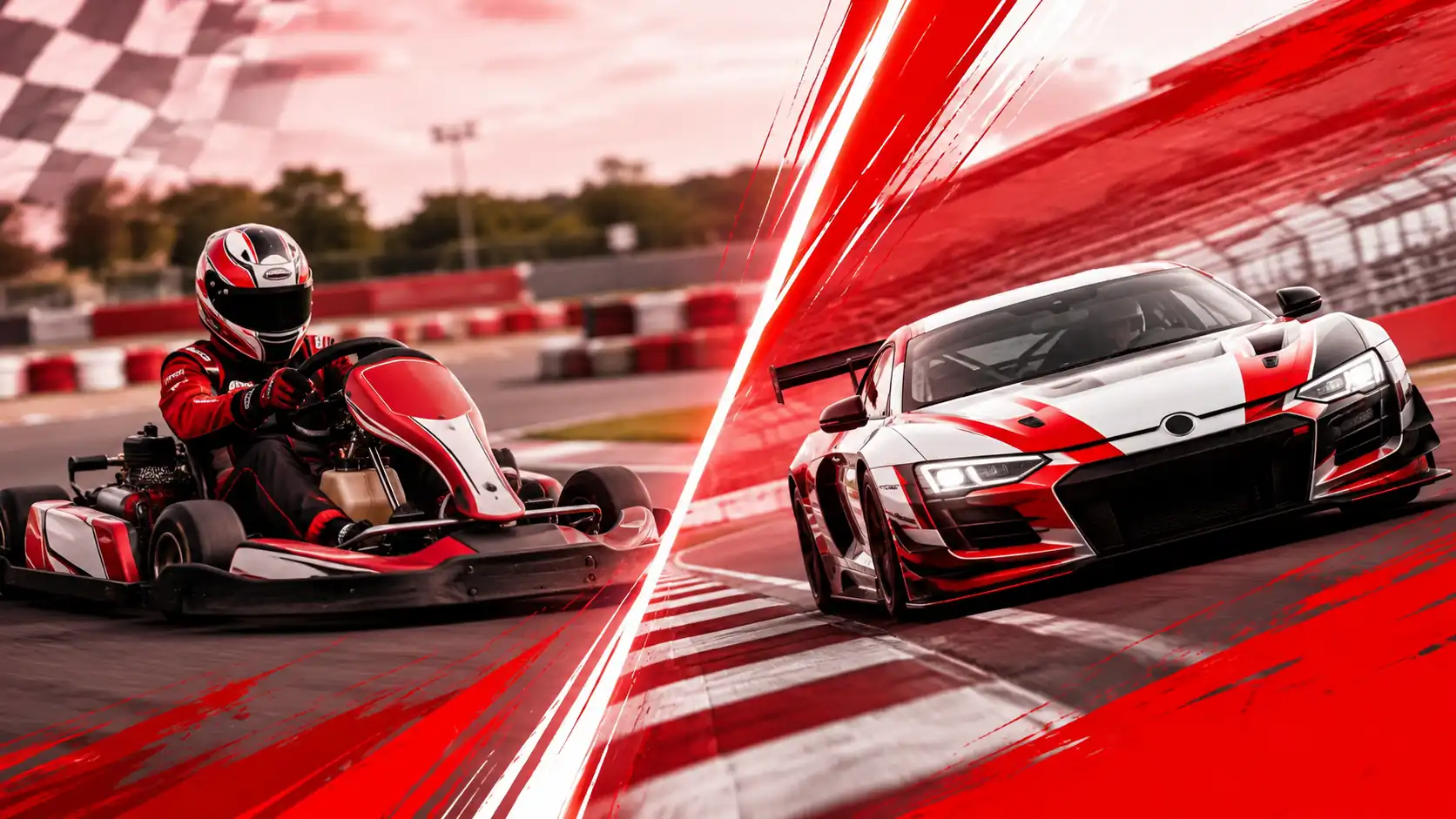
If you've never sat in a race machine before, the karting vs car racing question feels bigger than it is. It isn't really "either/or" — it's a sequence. We've helped 1,000+ riders and drivers book their first race weekend through Racesforall. This is the question almost all of them ask first.
Most drivers on India's FMSCI grids started in a kart. That's true from club-level Sunday racers up to national champions. Here's what you'll cover: cost differences, age and license rules, safety comparisons, and which one to book first.
Curious what karting and track day sessions are running near you?
Browse Live Events →What's the Real Difference Between Karting and Car Racing in India?
Karting means racing a lightweight, engine-driven go-kart — usually 5 to 13 horsepower for rental karts, up to 30+ horsepower for competition karts — around a short, tight circuit. Car racing covers everything from a hot-hatch track day to single-seater FMSCI championship racing, with far higher speeds, weight, and mechanical complexity.
Here's the thing — karting isn't a "lesser" version of car racing. It's a discipline of its own, with its own national championship, its own FMSCI license category, and drivers who compete in karts for years by choice. But for a beginner deciding where to spend their first rupee, the two options behave very differently.
Speed, Machine and Skill Focus
A rental kart tops out around 60–70 km/h; a competition car easily doubles or triples that on a straight at MMRT Chennai. Karting rewards precision — late braking, tight lines, minimal steering input. Car racing adds variables karting doesn't have: gear shifts, weight transfer, tyre degradation, and aerodynamics at higher categories.
Most beginner car events in India are short sprint races rather than endurance rounds, and you'll spend as much time learning pit lane etiquette as you will on track.
How Much Does It Cost to Start Karting vs Car Racing in India?
The karting vs car racing decision usually comes down to cost before anything else. Karting is cheap enough to try on a whim; car racing is a real financial commitment even at entry level.
Karting Costs vs Car Racing Costs at a Glance
- Arrive-and-drive karting: ₹250–₹1,200 for an 8–10 lap session, depending on the city and whether the track is indoor, outdoor, or a premium venue.
- Competition karting: Kart hire plus race entry typically runs ₹8,000–₹20,000 per event weekend, once you're racing under an FMSCI Karting license.
- Beginner car track day: ₹5,000–₹15,000 for a supervised session in a shared or rental car, before you own or lease anything.
- Beginner FMSCI car race weekend: ₹25,000–₹60,000+, covering car hire, entry fees, fuel, and tyres — and that's before factoring in racing gear.
Multi-lap karting packages usually save 15–25%, and weekday sessions run cheaper than weekends at most Indian rental tracks. Car racing doesn't have that kind of low-stakes entry point — every session on track costs real money the moment an engine starts.
| Factor | Karting | Car Racing |
|---|---|---|
| Entry cost (first session) | ₹250–₹1,200 | ₹5,000–₹15,000+ |
| Minimum age | ~5 (rental), 8 (FMSCI Junior license) | 18 (FMSCI Competitor license) |
| License needed to try casually | No | Usually no, for a supervised track day |
| License needed to race competitively | FMSCI Karting Junior/Senior | FMSCI Competitor (Four-Wheel) |
| Top speed (typical) | 60–120 km/h depending on class | 150–250+ km/h depending on category |
| Best for | Building racecraft cheaply, kids and teens, quick fun sessions | Committed racers ready for higher stakes and cost |
Ready to compare prices for real events near you instead of estimates?
Check Live Pricing →What Age Can You Start Karting or Car Racing in India?
Karting wins on accessibility. Most arrive-and-drive rental circuits accept kids from around age 5, provided they clear the minimum height requirement of roughly 4 feet — height matters more than age for rental karts, since it's a safety-harness and pedal-reach issue, not a rule about maturity.
Competitive karting under FMSCI runs on a Junior category starting around age 8, moving into Senior classes as riders age up. Car racing is a different story: an FMSCI Competitor license for four-wheel motorsport generally requires you to be 18 and hold a valid road driving license, though a handful of junior single-seater programs accept younger drivers under closer supervision.
Do You Need an FMSCI License for Karting or Car Racing?
Not for a casual session — you can walk into most rental karting arenas in India without any license at all. The moment you enter a sanctioned race, though, FMSCI licensing kicks in for both disciplines.
FMSCI recognizes seven broad license types, and the two that matter most to a beginner are the Karting license (Junior or Senior) and the four-wheel Competitor license. There's also a One-Event License for first-timers who want to try a single sanctioned race weekend before committing to a full annual license — a useful, lower-cost way to test the water in either discipline.
FMSCI License Types Beginners Actually Need
- Karting Junior/Senior license: Age-graded, required for FMSCI-sanctioned kart races, not for rental sessions.
- Competitor (four-wheel) license: Required for any sanctioned car race, minimum age 18 with a valid driving license.
- One-Event license: A cheaper, single-weekend option for first-timers testing either discipline.
For the full breakdown of costs, documents and the application process, see our FMSCI License Guide 2026.
Is Karting or Car Racing Safer for a Beginner?
Karting is the lower-risk option for a genuine first-timer, mostly because of lower speeds and simpler machines — there's no gearbox to misjudge and less mass to manage in a spin. Car racing introduces more variables at once: braking distances, tyre grip, and mandatory safety equipment like an ARAI-approved helmet, a homologated racing suit, and often a HANS device (a head-and-neck restraint that limits whiplash in a crash) at higher categories.
Picture this — you've just booked your first track day in a car at Kari Motor Speedway. You've got a helmet, but nobody told you it needs to be ARAI-approved to pass scrutineering — the pre-race safety and vehicle check every car and kart must pass before taking the grid. Here's what most first-timers don't check, and it's exactly the kind of thing that gets you turned away at the gate before you've turned a single lap.
Both disciplines are managed risks once you race under a scrutineered, FMSCI-affiliated event rather than an unregulated track meet. Our Track Day Gear Checklist India covers exactly what you need before you show up.
Does Karting Experience Actually Help You Become a Better Car Racer?
Yes — and this is the strongest argument for starting in a kart even if your end goal is always cars. Karting builds racecraft at low cost and low risk: reading a racing line, braking late without locking up, judging a gap in wheel-to-wheel traffic. Those instincts transfer almost directly once you move into a car, where mistakes cost far more in repairs and entry fees.
In our experience talking to racers who book through Racesforall, almost every driver competing in India's F1600 and club car categories logged serious kart hours first. It's not a rule, but it's close to one — most driving coaches in India still recommend a season or two of karting before a driver's first car race weekend.
- Racing lines: Karting teaches the fastest way around a corner at low cost, before a car makes the same lesson expensive.
- Braking points: You learn to brake later and more consistently in a kart — a skill that carries straight into a car.
- Wheel-to-wheel racecraft: Close, low-speed karting battles build the judgment you need for higher-speed car racing.
Where Can Beginners Try Karting or Car Racing in India?
Chennai's MMRT and Coimbatore's Kari Motor Speedway are the two circuits Indian beginners hear about most, and for good reason — both run FMSCI-sanctioned race weekends alongside beginner-friendly track days and karting sessions. If you want the full layout, booking process, and what to expect at MMRT specifically, read our MMRT Circuit Guide.
Beyond the two major circuits, most metros — Bangalore, Mumbai, Pune, Hyderabad, Delhi NCR — have arrive-and-drive karting arenas that make a decent low-stakes first taste, even if you never plan to race competitively. Just remember India's racing calendar skews toward November–February, since the monsoon months make most outdoor circuits unsafe or fully closed for sanctioned events.
A typical FMSCI race weekend runs through scrutineering, a race briefing, sighting laps and qualifying before the grid start — worth knowing whether you're entering in a kart or a car.
So Which Should You Start With as a Beginner?
By now the karting vs car racing decision should be about your budget and goals — not guesswork. Start with karting if you're under 18, on a tight budget, or you've genuinely never driven anything on a closed circuit before. It's cheap enough to try more than once, safe enough for nervous first-timers, and it teaches you whether you actually enjoy wheel-to-wheel competition before you spend real money finding out.
- Try arrive-and-drive karting first. A single ₹250–₹1,200 session tells you more about whether racing is for you than any amount of reading.
- Log a few competitive kart sessions. Build racing lines and racecraft under real (if smaller-stakes) pressure.
- Get your FMSCI paperwork sorted early. Apply for a One-Event or full Karting license once you know you want to race, not just drive.
- Graduate to a car track day. Book a supervised beginner session before jumping straight into a sanctioned car race.
- Move into FMSCI Competitor racing. Once you're 18, licensed, and have logged real seat time, you're ready for a full car race weekend.
If you're already 18, have a driving license, and your budget can absorb ₹25,000–₹60,000 for a race weekend without blinking, there's nothing wrong with going straight to cars. What most event listings won't tell you is that skipping karting doesn't disqualify you — it just means your first few car sessions double as the racecraft lessons karting would have given you for a lot less money.
Frequently Asked Questions
Is karting cheaper than car racing in India?
What age can you start karting or car racing in India?
Do I need an FMSCI license to try karting or car racing?
Does karting experience actually help with car racing?
Is karting or car racing safer for a first-timer?
Where can beginners try karting or car racing in India?
Can I skip karting and go straight into car racing?
Join 1,000+ riders and drivers who've booked their races through Racesforall.
Find Your Next Event →